
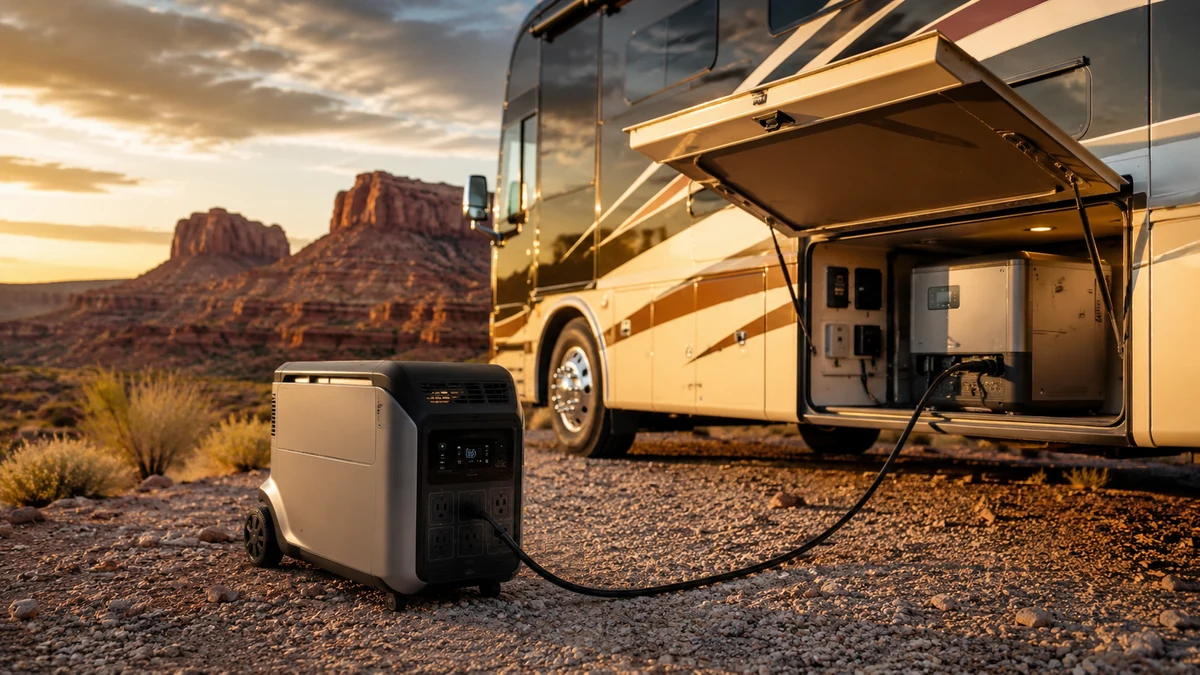
EcoFlow Delta Pro 3 Review (2026): 4kWh Boondock Champion for Real Class A / 50A RVs
Affiliate disclosure: This post contains affiliate links. As an Amazon Associate I earn from qualifying purchases. Product picks were chosen on the merits — no brand pays for placement.
How we evaluated: This review is based on manufacturer specs, owner reports, and editorial analysis. WildJoule has not hands-on tested this product. Our evidence standard
This EcoFlow Delta Pro 3 review is for the buyer deciding whether the 4kWh flagship is worth it. The EcoFlow Delta Pro 3 is the portable power station most people should stop debating and just buy — if they need real Class A / 50A RV output. This review walks through the four specs that determine whether it actually fits your rig, honest weaknesses (yes, it weighs 113 lb), and who should skip it entirely.
WildJoule verdict
For serious Class A boondockers and 30/50A RVs, the Delta Pro 3 is the most capable single-unit portable power station on Amazon in 2026. Its 8,000 W surge handles residential-fridge and rooftop-AC startup spikes that trip smaller units. Expandable to 12+ kWh. Skip only if you camp under 10 weekends per year — it’s overkill and you won’t amortize it.
Price: Prices on Amazon change frequently. Click the button below to view the latest price and any available discounts.
This is the biggest unit on the site, and the most important thing I can tell you about it is to stop and ask whether you actually need this much. Four kilowatts, expandable further, is built for a specific buyer: someone powering a whole house through outages, running genuinely power-hungry things — fridge, washing machine, AC, computers — or living somewhere they need everything on at once. If that is you, and especially if you are pairing it with solar to recharge, this is the right tool, and the brand’s track record and warranty behind it are strong. But be honest with yourself about the trade-offs, because they are real: it is expensive, it is heavy, and it is physically big. Most people who think they need 4kWh actually don’t — they need a calmer look at their real loads first. Buy this because the math says you need it, not because bigger feels safer.
Key specifications
| Battery capacity | 4,096 Wh |
| Battery chemistry | LiFePO4 (LFP) |
| AC continuous output | 4,000 W |
| AC surge / peak | 8,000 W |
| Cycle rating | 4,000 cycles to 80% |
| Solar input ceiling | 2,600 W |
| Wall charge time (manufacturer claim) | ~50 min |
| Weight | ~113 lb |
| Ports | 5× AC, 30A RV plug (via included adapter), 240V split-phase (with EcoFlow Smart Home Panel), 100W USB-C PD, USB-A, DC |
| Expandable to | 12+ kWh with additional batteries |
| Price tier | $$$ |
Pros and cons
Pros
- ✓8,000 W surge starts residential fridges and rooftop AC
- ✓2,600 W solar input — best in class for real off-grid recharge
- ✓Expandable to 12+ kWh — future-proof for growing setups
- ✓LiFePO4 with 4,000-cycle rating (10+ years of weekend use)
- ✓EcoFlow app + Smart Home Panel integration for home backup
Cons
- ✗Heavy — 113 lb is a two-person lift or wheeled roll only
- ✗Highest price tier — not for casual weekend campers
- ✗30A RV plug requires included adapter (not native TT-30R)
- ✗240V split-phase needs the extra Smart Home Panel purchase
- ✗Faster “50 min” charge is a lab-conditions manufacturer claim; expect longer in real use
The four specs that actually matter
Battery capacity — 4,096 Wh in real RV terms
4 kWh sounds abstract until you translate it to loads. A 12V RV fridge pulling ~1,200 Wh/day means the Delta Pro 3 can run it for ~3 days without any input. Add lights, fan, phone charging (another ~400 Wh/day), and you’re looking at 2.5 days of typical small-to-mid RV boondocking. That’s a real long weekend without ever starting a gas generator.
For 30A rigs (which pull up to 3,600 W continuous when everything’s on), 4 kWh runs the entire trailer for roughly 6-8 hours of typical usage. For 50A rigs, it depends heavily on whether you’re running AC.
8,000 W surge — the spec RVers miss
This is the number that separates the Delta Pro 3 from every 2,000 W unit on the market. Residential refrigerator compressors spike 800-2,000 W on startup. Rooftop RV air conditioners spike 3,000-5,000 W. Window ACs spike 2,000-3,500 W. If your inverter can’t handle the spike, the load trips and the appliance never starts.
8,000 W surge headroom is why the Delta Pro 3 can start basically any household appliance you’d realistically plug in — and why 2,000 W units routinely fail on residential fridges.
2,600 W solar input — best in class
Most “best of” lists ignore solar input ceiling. It kills more boondocking dreams than any other spec. A 2,000 Wh unit with 400 W solar input takes 5+ full sun hours to recharge one full cycle — meaning it can’t keep up with daily use.
The Delta Pro 3’s 2,600 W solar ceiling means you can pair it with a 2,000+ W solar array and recharge in a single day. That transforms it from a “3-day battery” into an indefinite off-grid system.
Port layout — 30A adapter, no native TT-30R
Honest note: the Delta Pro 3 does not have a native 30A RV plug like the Bluetti AC200L. It includes a 30A adapter, which works but adds one more connection to fail. If native 30A plug-and-play matters to you and you don’t need the Delta Pro 3’s larger capacity, the Bluetti AC200L is worth considering.
How it compares to alternatives
The Delta Pro 3’s direct competitor in 2026 is the Anker SOLIX F3800 Plus, which has similar capacity (3,840 Wh) and higher continuous output (6,000 W). The differentiator: the F3800 Plus has native 120V/240V split-phase output built in (no extra Smart Home Panel required). If you want to run a residential well pump or 240V dryer, the F3800 Plus is more elegant. For pure RV use, the Delta Pro 3 wins on ecosystem and app.
For weekend campers who don’t need this much capacity, see the Anker SOLIX C1000 Gen 2 — 1 kWh for a fraction of the price. Or the full lineup in our best portable power station for RV living guide, or the complete portable power stations guide for every capacity class.
Best for and skip if
Best for
- Class A motorhome owners who want to boondock 10+ weekends per year
- 50A RV owners who occasionally run rooftop AC on battery
- Full-timers who split time between rig and home backup
- Serious boondockers pairing with 1,500-2,600 W solar arrays
- Hurricane-country homeowners who also want RV-portable backup
Skip if
- You camp under 10 weekends per year — this is overkill, get the Anker C1000 Gen 2 instead
- You need the lightest 2 kWh unit for solo van life — see the Jackery 2000 v2
- You have a 30A travel trailer and want plug-and-play — see the Bluetti AC200L with its native 30A plug
- Your budget is under $2,000 — this unit is in the $$$ tier
Final verdict
Our verdict
If you need real Class A / 50A RV power and can amortize the price over multiple boondocks per year, the EcoFlow Delta Pro 3 is the most capable single-unit portable power station on Amazon in 2026. The 8,000 W surge and 2,600 W solar input are the specs that matter for serious boondocking — everyone else is playing catch-up. Skip only if you’re a light user or need something smaller for van life.
For solar, the EcoFlow 400W portable panel review covers EcoFlow’s own folding panel. If you are weighing this against a wall battery, read Delta Pro 3 vs Powerwall 3.
Don’t need 240 V? A 120 V-only 2 kWh unit costs and weighs less: see our EcoFlow DELTA 3 Max review, or the DELTA 2 Max review if solar charging is the priority.
Frequently asked questions
Will the Delta Pro 3 run a rooftop RV air conditioner?
For short periods, yes. The 8,000 W surge handles the compressor startup, and 4,000 W continuous handles most residential/RV rooftop ACs. Expect 4-6 hours of AC-only runtime from a full charge. For continuous overnight cooling, you need a dedicated inverter + house battery bank.
How does the Delta Pro 3 differ from the Delta Pro (original)?
The Delta Pro 3 is a full redesign — larger battery (4,096 vs 3,600 Wh), higher surge (8,000 vs 7,200 W), more solar input (2,600 vs 1,600 W), and now uses LiFePO4 chemistry (the original used older NMC lithium). If you’re comparing new listings, always get the “3.”
Can I use it for whole-home backup?
Yes — but you’ll need the EcoFlow Smart Home Panel (sold separately) to wire it into your critical-loads panel for automatic switchover. Without the panel, you can only power appliances that you manually plug in.
How reliable is the manufacturer’s 50-minute charge claim?
50 min is EcoFlow’s X-Stream fast-charge mode on a 1,800+ W AC input. In practice, standard household outlets (15A, ~1,500 W max) deliver closer to 60-75 min for a full charge. Still class-leading — but expect longer than the headline number.
Is 113 lb realistic to move solo?
No. The Delta Pro 3 has built-in wheels and a telescoping handle for rolling on flat surfaces, but lifting into a Class A basement bay or up RV steps needs two people. Plan storage accordingly.
Last updated: June 12, 2026. We update this review as EcoFlow releases firmware changes or as real-world tester data becomes available. Spotted something out of date? Let us know.